Why heating can restore electrical performance—and why the problem may return.
Polyimide is widely used in microelectronics for insulation, protective coatings, and solder dams.
It’s an excellent insulator. But under certain conditions, it can contribute to unwanted electrical leakage.
Moisture is one possible reason. The way the polyimide was processed may be another.
An unexpected test result
Consider a device with polyimide solder dams. During electrical testing, leakage current exceeded its limit.
After heating, the current dropped back within specification.
No conductor was repaired. No physical short was removed.
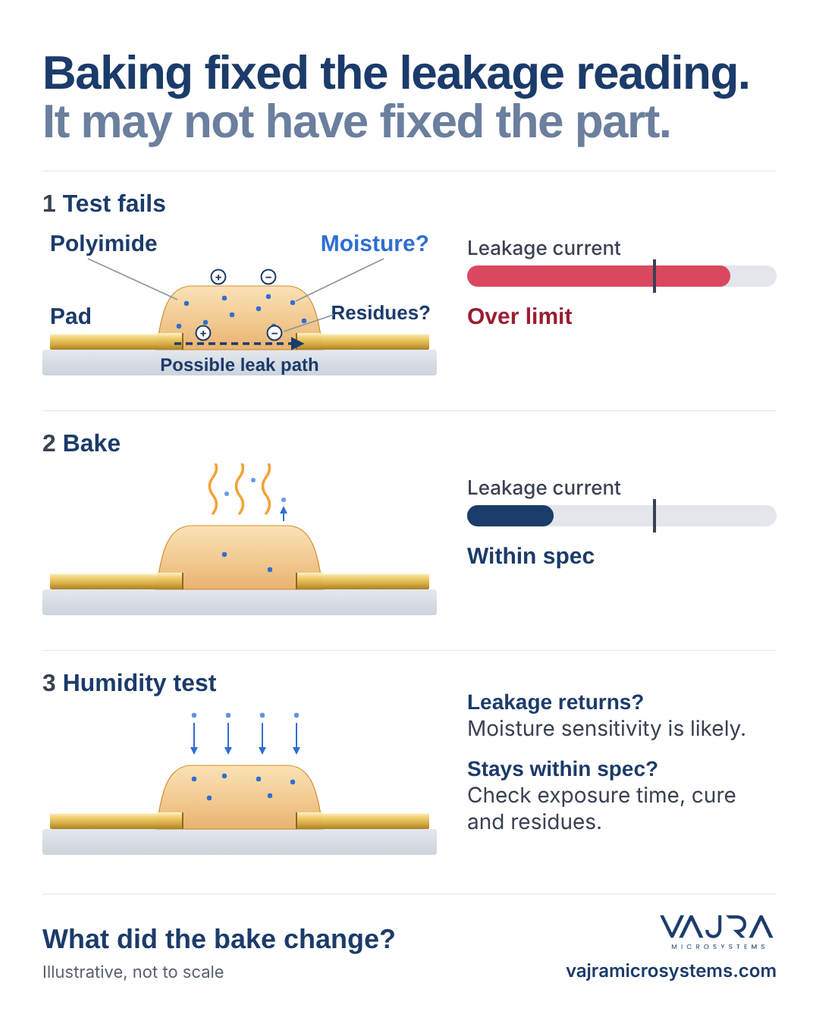
What might the heat have changed?
1. Moisture was removed.
Polyimide naturally absorbs moisture from the air, even when it looks dry.
Moisture can contribute to leakage, particularly when ionic contamination is present. Residues from fabrication, plating, or soldering can make the problem worse.
Heating can drive out absorbed moisture and reduce leakage. But if moisture returns, the problem may return too.
2. The polyimide wasn’t fully cured.
Some polyimides begin as a precursor called polyamic acid. During curing, heat converts this precursor into polyimide.
If curing is incomplete, the remaining precursor material can affect moisture absorption and electrical behavior. Additional heating may change the material more permanently.
The two explanations aren’t mutually exclusive. Incomplete curing can also make some polyimide films more sensitive to moisture.
3. Residues were removed or changed.
Heating may also remove residual solvents or alter contamination on the device, reducing leakage without necessarily changing the polyimide itself.
How do you find the cause?
Start by checking whether the improvement lasts.
Measure leakage after drying, expose the device to controlled humidity, and measure it again.
Allow enough time for moisture to enter the material. A short exposure could make a temporary improvement appear permanent.
If leakage repeatedly rises with humidity and falls after drying, moisture sensitivity becomes a stronger explanation.
If the improvement remains, investigate whether heating changed the polymer, its interfaces, or residual contamination. Reviewing the original cure process can also help.
The goal is to identify where the leakage occurs and what causes it before changing the manufacturing process.
Why does it matter?
Moisture-related leakage isn’t always harmless.
In some structures, moisture, ionic contamination, and electrical bias can promote metal migration, potentially creating a permanent electrical short.
The lasting solution might involve better cleaning, an improved cure process, different material selection, or protecting sensitive interfaces.
The bigger lesson
A successful bake tells us that electrical performance improved.
It doesn’t tell us whether the underlying problem was eliminated.
The real engineering work is understanding what the bake changed.
At Vajra Microsystems, we work with thin films, polymers, metallization, and specialized microfabrication—where process details can make a significant difference in electrical performance and reliability.


Leave a Reply